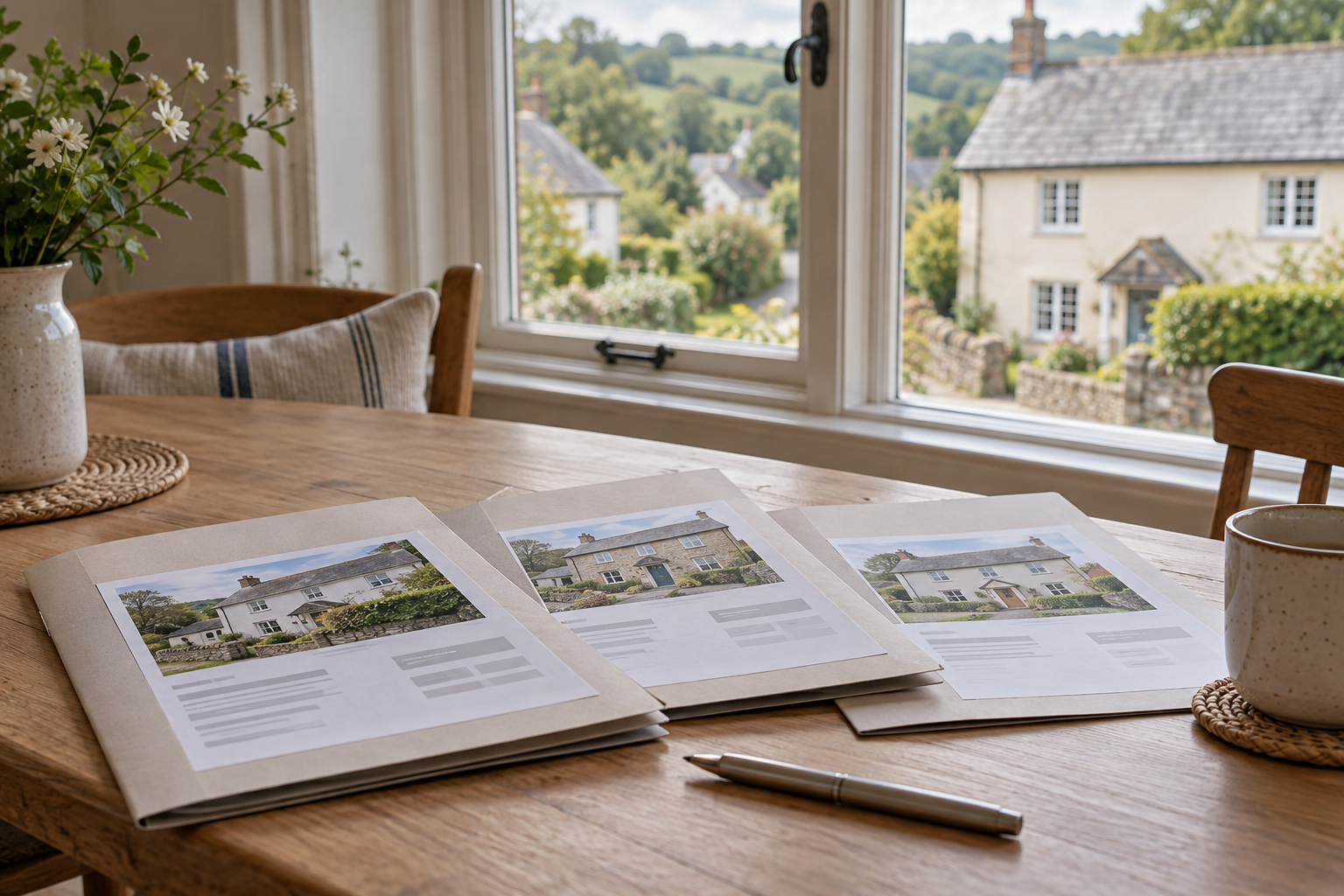
If you’re comparing estate agent valuations in Mid Devon, different suggested prices can leave you wondering what your home is actually worth. The most useful comparison is the evidence and sales approach behind each figure.
You invite three agents round. They see the same house, walk through the same rooms and look at the same garden. Then they give you three different opinions.
One suggests £325,000. Another says £340,000. The third thinks you could achieve £360,000.
It’s tempting to favour the highest. Why wouldn’t you? A difference of £35,000 could make a considerable difference to your next move.
But before choosing, I’d want to understand how each agent reached their conclusion.
Why do estate agent valuations differ?
An estate agent’s market appraisal is an opinion of the price a property could achieve, informed by evidence and professional judgement. It isn’t a guaranteed sale price.
Agents may place different weight on recent sales, current competition, your home’s features and their experience of buyer demand. They may also have different views on how to launch it.
There can be a reasonable case for a range of prices. What matters is whether the agent can explain that case clearly.
The highest figure isn’t automatically unrealistic, and the lowest isn’t automatically the most accurate.
What evidence should support estate agent valuations in Mid Devon?
I’d expect an agent to talk you through relevant properties and explain how they compare with yours.
That means looking beyond the number of bedrooms. Floor area, condition, layout, parking, garden, outlook and location can all affect the comparison.
A three-bedroom house in Cullompton may offer a very different proposition from a three-bedroom cottage in Culmstock. Even two homes on the same road can have differences that matter to buyers.
Ask which examples are:
- Completed sales, with a recorded price achieved.
- Sold subject to contract, where the transaction hasn’t completed and the agreed price may not be publicly available.
- Currently for sale, showing what buyers can choose and what sellers are asking.
You can check recorded transactions through the government’s sold property price search. But a sold price alone won’t explain the property’s condition or the circumstances of the sale.
Current asking prices are useful context too. They show the competition, rather than prove what a buyer will pay.
Is the suggested figure a valuation or a launch price?
This is worth clarifying.
An agent might believe a home is likely to achieve somewhere between £325,000 and £340,000, then recommend launching at £340,000. Another might suggest a lower asking price to attract a different level of interest.
Those are marketing decisions that need explaining.
I’d ask:
- What price do you realistically expect us to achieve?
- Why do you recommend this particular asking price?
- Which competing homes will buyers compare us with?
- What response would indicate that the approach is working?
- When will we review it, and what evidence will guide that conversation?
You don’t need a promise. You need a reasoned recommendation and a clear understanding of the options.
Should you choose the agent with the highest valuation?
Only if you’re comfortable with the reasoning and the service behind it.
A higher price should come with a convincing explanation of why buyers would pay it. Equally, a lower recommendation should explain why a more ambitious figure is unlikely to succeed.
Be cautious about making your decision on an appealing number without discussing how the agent intends to achieve it.
I’d also want to know who will handle enquiries, conduct viewings, negotiate offers and keep you informed. Agree how often you’ll receive updates and what those updates will cover.
The valuation appointment is a useful opportunity to see how someone listens, explains their advice and responds when you challenge it.
What if you want to try a higher asking price?
That’s a conversation to have openly.
There may be a case for testing a more ambitious price, provided you understand the reasoning and the possible consequences. Agree what you’ll monitor and when you’ll review the response.
If enquiries are limited, or buyers consistently choose competing properties, that should prompt a meaningful discussion.
My guide to what to review if your home isn’t selling in Mid Devon explains how I approach that review.
Choose advice you can make a decision with
A useful appraisal should leave you understanding the likely price range, your launch options and the reasons behind them.
It should also take account of what you want to achieve. Your timescale, onward plans and appetite for uncertainty all belong in the conversation.
If you’re selling and buying, my article on understanding your price to change explains why the gap between those two prices matters.
When comparing estate agent valuations in Mid Devon, look for advice that stands up to questions. You should feel able to ask how a figure was reached and receive a straightforward answer.
If you’re considering selling in the Culm Valley, Blackdown Hills or Mid Devon, I’m happy to talk through the evidence, your options and a sales approach that fits your move.
By Paul Furner, Paul Furner Homes